For many professionals, the Windows operating system is the most familiar example of how complex technology is made usable. It quietly coordinates hardware, applications, security, and updates so users can focus on getting work done. Learning about S4HANA services becomes far more intuitive.
At the enterprise level, S4HANA functions much like Windows does for a PC, it is the foundational platform that keeps business processes running smoothly, securely, and in real time.
S4HANA as the Enterprise Operating System
Windows sits at the center of a computer, managing memory, processors, storage, and application execution. In a similar way, S4HANA operates as the core system for an enterprise. Instead of managing files and programs, it coordinates finance, supply chain, manufacturing, human resources, and analytics within a single digital environment.
Just as users rely on Windows to ensure applications can communicate with hardware, organizations rely on S4HANA services to ensure business functions share consistent, real-time data.
The in-memory architecture of S4HANA is comparable to a highly optimized OS kernel, designed for speed, efficiency, and immediate responsiveness across the entire system.
Managing Resources at Scale
Windows performance depends on how well it allocates CPU cycles, RAM, and disk access among running applications. When the operating system is optimized, everything feels fast and responsive. S4HANA services apply the same principle at an enterprise scale.
S4HANA manages massive data volumes and transaction loads by intelligently distributing processing across system resources. Real-time analytics are embedded directly into operational workflows, much like Windows Task Manager gives visibility into system performance.
Organizations can monitor, adjust, and optimize processes without waiting for overnight batch jobs, ensuring that enterprise operations remain responsive under pressure.
From Desktop to Business Dashboard
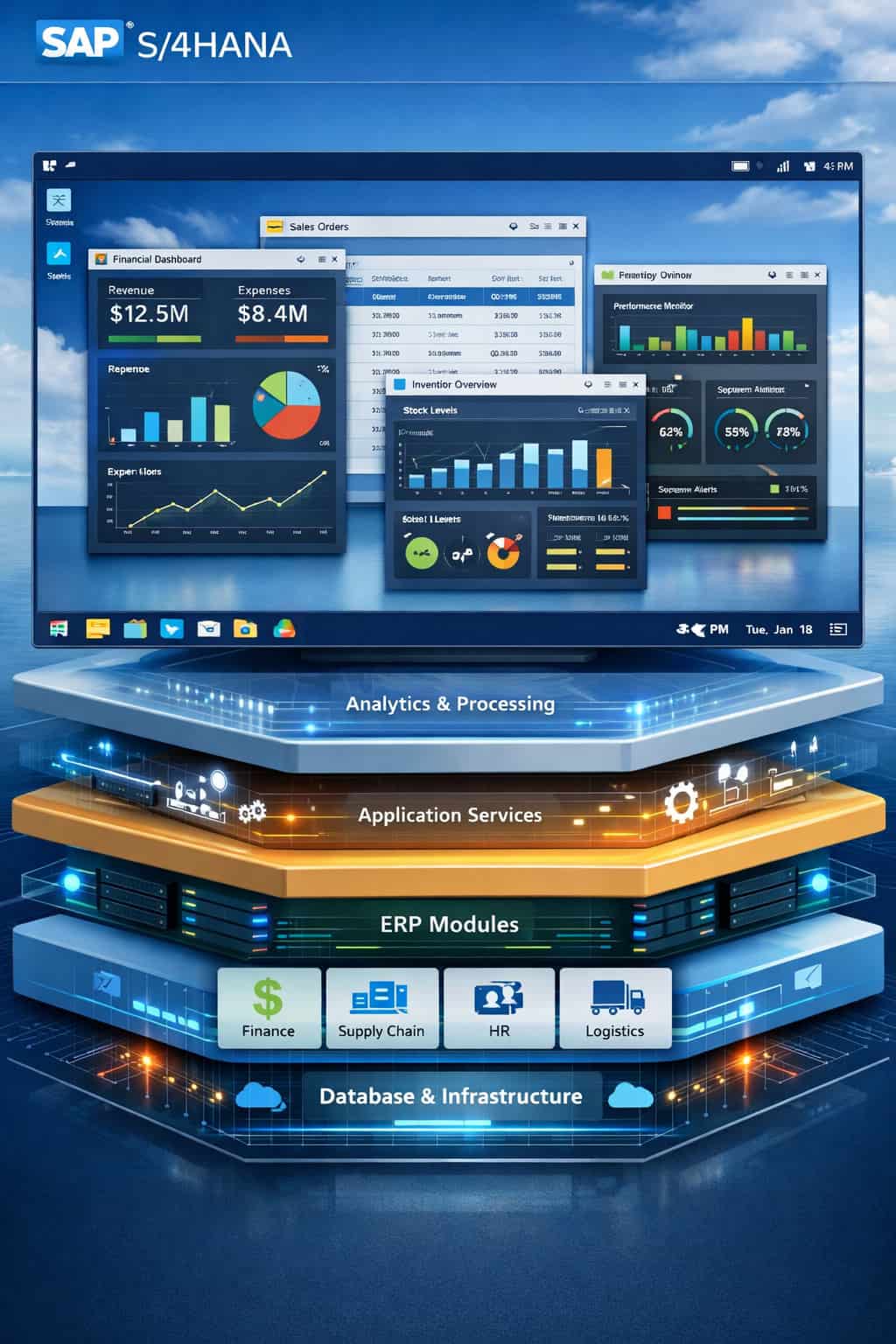
One of Windows’ greatest strengths is its familiar user interface, which hides technical complexity behind icons, menus, and workflows that users quickly learn. S4HANA services take a similar approach through modern interfaces.
Instead of forcing users to navigate rigid, legacy screens, S4HANA delivers role-based dashboards tailored to finance teams, operations managers, or executives. This mirrors how Windows presents different tools to different users while running on the same underlying system. The result is an ERP environment that feels less like a technical system and more like a productivity platform.
Security, Updates, and Stability
Windows users expect regular security patches, system updates, and stability improvements without needing to rebuild their computers. S4HANA services deliver the same promise at an organizational level. Built-in security controls, compliance frameworks, and continuous innovation protect enterprise data while allowing systems to evolve.
Updates enhance functionality without disrupting core operations, much like Windows feature releases improve productivity while preserving compatibility. This balance between innovation and stability is what allows enterprises to operate confidently in changing markets.
By viewing S4HANA services through the Windows ecosystem, complex ERP concepts become easier to grasp. S4HANA is not just software, it is the operating system of the modern enterprise, quietly orchestrating resources, users, and data so organizations can run efficiently, securely, and at scale.